UX Design Sprint  ·  3 Week Team Project

Kindle

Designing for Solitude and Connection

Adding social reading to Kindle without disturbing the quiet that makes it worth opening in the first place.

Research UX Strategy Ideation Prototyping Testing
01

The Brief

In this concept project, Kindle was looking to evolve beyond a solo reading tool. The objective was to explore how avid readers read, track progress, share reflections, and connect with like-minded individuals, and to then use those findings to guide how Kindle might support shared reading and meaningful discussion without losing what makes the experience so valued.

Kindle e-reader resting on grass in a felt sleeve outdoors
02

Project Overview

Kindle has long been a sanctuary for solitary reading. It is a calm, immersive space where readers step away from the noise of daily life. Reading culture however has become more social in recent times. Communities on BookTok, WhatsApp groups, and digital book clubs are changing the way readers can share reactions, discuss passages, and discover new titles together.

The problem is that these conversations rarely happen where the reading actually occurs. Instead, readers are moving between multiple platforms — they might discover books on social media, track their progress on StoryGraph or Goodreads, and discuss them in an entirely separate space.

Readers described their reading journey as "scattered" and "more complicated than it should be."

This fragmentation raised the central question for the project: how might Kindle support social reading while preserving the calm, immersive experience readers value most?


Cosy reading armchair lifestyle shot — Kindle persona research
03

The User We Designed For

Emily — The Restorative Reader

"I want a deeply immersive and private reading experience that protects my mental escape, with the option to quietly share something meaningful with a trusted person if I choose."

Emily is an avid reader who treats reading as a personal sanctuary — a moment of calm in an otherwise demanding life. She occasionally shares meaningful passages with people she trusts, but has little interest in large public communities or performance-driven platforms.

Goals

  • Protect the immersive quality of her reading experience
  • Connect with trusted readers in a low-pressure way
  • Stay motivated to keep reading

Barriers

  • Reading feels private and restorative — not something to perform publicly
  • Social features on other platforms feel performative or distracting
  • The reading journey is split across too many tools
04

The Crux Of The Issue

Readers weren't asking for another social platform. Many actively resisted the idea of reading becoming overly social. What they wanted was control — over when they shared, who they shared with, and ultimately how visible their activity was.

The real barrier wasn't a lack of social features. It was that no tool gave readers the option to be social on their own terms.

05

The Research

We conducted user interviews alongside competitive and comparative analysis, and heuristic evaluations of Kindle and competitor platforms. The goal was to understand how readers currently engage with books, track progress, and participate in social discussion.

Three clear insights emerged that would shape every design decision in the project.

Prioritisation board with sticky notes arranged by impact and effort

Insight 01

Reading as Restoration

Participants consistently described reading as a way to regulate stress and reclaim calm. The immersive experience was something worth protecting — not disrupting.

Insight 02

Fragmented Journeys

The reading experience was split across multiple tools. Discovery, tracking, and discussion each happened somewhere different. No single platform held it all together.

Insight 03

The Social Paradox

Readers wanted connection — but not at the cost of immersion. They craved small-scale, contextual interaction with trusted people, not public performance.

06

The "Aha" Moment

During ideation, the temptation was to design Kindle as a social platform — to add more features, more feeds, more community tools. But research pointed somewhere different.

The breakthrough came when we reframed the challenge entirely:

How Might We

How might we introduce social features that enhance connection without interrupting immersive reading?

The answer wasn't to redesign Kindle. It was to build carefully around what readers already loved about it.

Glowing lightbulb held in cupped hands against dark background
Neon sign reading 'This is the sign' against a brick wall
07

Reframing The Problem

Initially, the brief pointed toward building out social and community features. But research suggested that more features weren't the answer. It was actually more control that was needed.

Readers didn't want to see big change from Kindle, or for it to become a social platform. They wanted the option to dip in and out of connection without ever feeling like their reading space had been taken over.

This reframing shifted the design direction from "social reading platform" to "optional, reader-controlled social layer" — enabling us to augment the existing experience rather than replacing it entirely.

08

The Kindle Solution

Four core features, each directly addressing a research insight. Nothing added for its own sake.

Feature 01

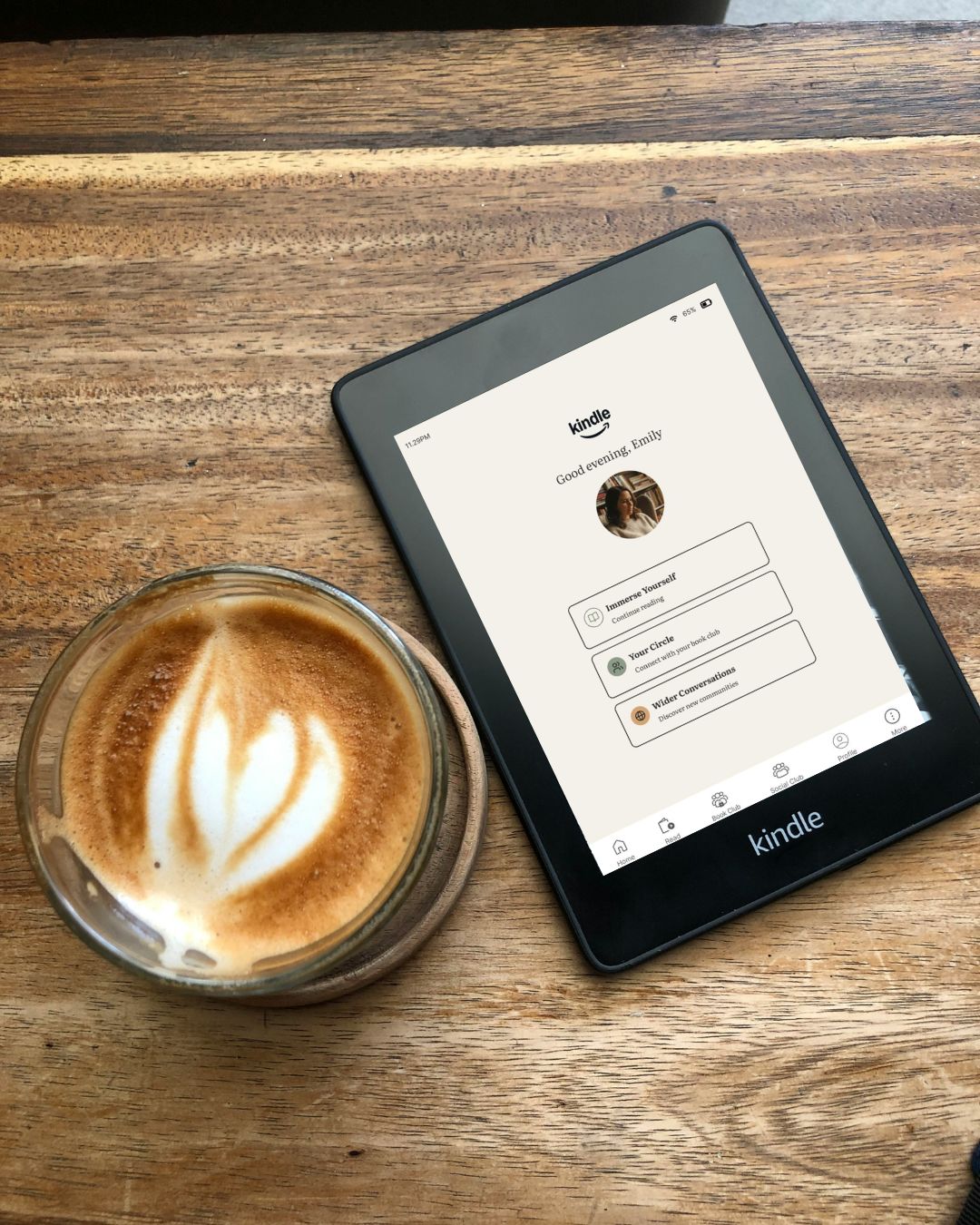
Three Reading Modes

Full Immersion, Private Group, and Social Discovery — allowing readers to move fluidly between deep focus and social engagement without one interrupting the other.

Feature 02

Private Group Reading

A small, trusted circle where readers can share highlights, discuss passages, and see each other's progress. Conversations are anchored directly to the text.

Kindle app screen prototype alongside a latte flatlay

Feature 03

Permanent Navigation

A clear, persistent bottom navigation bar replacing the hidden gesture that confused early testers — making mode switching feel effortless rather than accidental.

Feature 04

Goals & Progress Tracking

A dedicated goals page to support reading motivation and help users stay connected to their own progress — not just each other's.

The Prototype

See It In Action

09

Testing Insights

We conducted usability testing across two prototype stages with six participants per round, asking each to complete three tasks: enter the reading space, switch to book club, and return to reading. The impact of testing shaped three significant outcomes.

Refinement

Navigation Overhaul

5 of 6 participants struggled to find the hidden navigation gesture. We introduced a permanent bottom nav bar, increased touch targets, and replaced ambiguous labels with clearer language.

Refinement

Discussion Space

The original felt too small and too focused on competitive elements. We expanded the conversation area, removed gamification badges, and prioritised dialogue over performance.

Refinement

Readability

4 of 6 participants found the interface cramped. We increased spacing, improved font sizing, and simplified the visual hierarchy.

Key Validation: Participants consistently described Reading Mode as calm and immersive, while still appreciating the ability to access social features when they wanted them. This confirmed the central hypothesis: social connection enhances reading as long as it stays optional and unobtrusive.

10

Reflection

This project reinforced something I keep coming back to in product design. Successful products rarely evolve by replacing what users love. Instead, they evolve by respectfully building around it.

Kindle already provides enormous value as a deeply immersive reading experience. Our job wasn't to redesign that foundation. It was to expand it thoughtfully.

Edison bulbs glowing against an industrial brick and graffiti wall

The Results — A Design That Respects Both User and Business

By designing for reader control rather than maximum social engagement, the Kindle concept delivers:

  • 1

    Retained Immersion. The reading experience remains undisrupted, protecting the quality users already rely on.

  • 2

    Meaningful Connection. Small-group features support the kind of quiet, contextual sharing readers actually want.

  • 3

    Ecosystem Expansion. A unified platform reduces the need to move between apps — keeping readers inside Kindle for more of their reading journey.

Got Questions?

I'd love to hear what you're working on.

If you'd like to find out more about this project, talk through how we might work together, or are simply curious about how I could support you — there are no wrong answers and no pressure. Just a conversation.

Let's Chat

Finished exploring?

← Back to All Case Studies

Want to work together?

Start a Conversation